
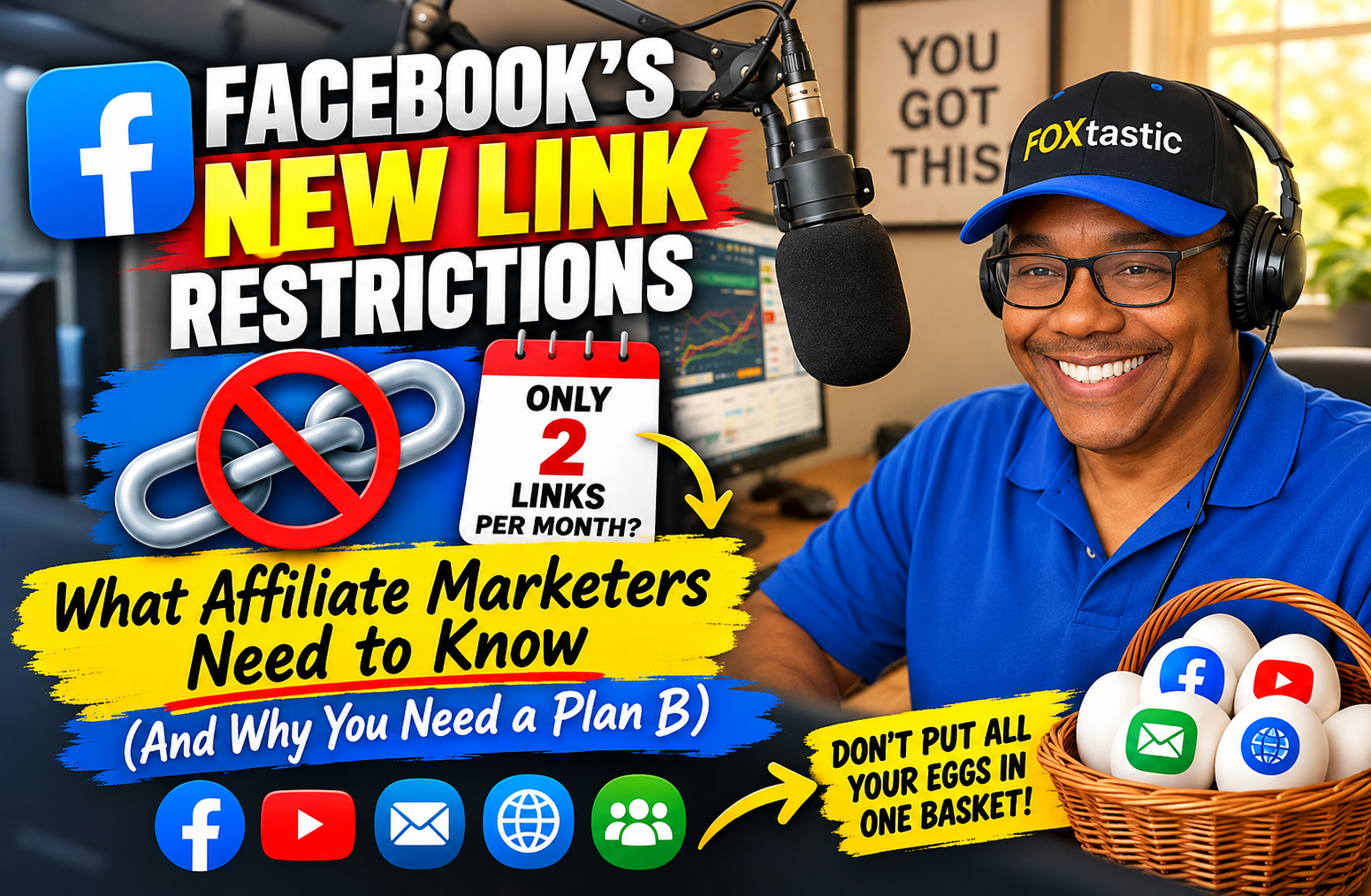
Recently, a member of our One Wise Link (OWL) community shared a post on our timeline about Facebook changing its rules for sharing external links. According to the post, some Facebook users are now being limited to just two links per month, including links placed in comments.
Naturally, that caught my attention.
Since so many affiliate and network marketers depend on Facebook to promote their businesses, I decided to do a little investigating to separate fact from fiction.
What I discovered is worth sharing. But more importantly, it reinforces something I’ve believed for a long time:
Never put all your marketing eggs in one basket, especially when someone else owns the basket!
What’s Actually Changing on Facebook?
In December 2025, Meta began testing restrictions that limited certain Facebook accounts to two organic posts containing external links per month unless they subscribed to a qualifying paid service.
In September 2026, reports indicated that Meta was expanding the restrictions to additional Facebook Pages as it introduced its Meta One subscription offerings.
Here’s what we know:
- Facebook business and creator Pages: Some are now restricted to two organic posts or comments containing external links per calendar month.
- Personal profiles using Professional Mode: Some were included in the original testing, although the latest expansion appears focused primarily on actual Facebook Pages.
- Regular personal profiles: These have not been included in the newer Page-focused restrictions.
- Links in comments: Under the newer Page restrictions, these can count toward the monthly allowance.
- YouTube and other external websites: Sharing a YouTube video link may count as an external-link post if your account is affected.
An important clarification: This is not a universal restriction affecting every Facebook user.
Meta is rolling out and testing these changes selectively. If your account is affected, you may see a notification or warning when attempting to publish a link.
And no, reaching your link allowance doesn’t automatically mean Facebook is going to suspend your account. The restriction concerns your ability to publish additional links without qualifying paid access.
Why Is Facebook Doing This?
I’ve seen people express frustration over these changes, and I understand why.
But I also look at this from a business perspective.
Facebook is a business. It isn’t a free advertising board created for affiliate marketers.
Meta invests enormous resources in maintaining its platforms, developing technology, and attracting users. Naturally, it wants to generate revenue from those investments.
By limiting certain free promotional features and offering expanded capabilities through paid subscriptions, Meta creates another potential revenue stream.
There’s also the matter of keeping people on Facebook.
When someone clicks a link that takes them to YouTube, an affiliate offer, or another website, they’re leaving Facebook’s environment. Keeping users engaged on its own platforms supports Meta’s advertising business.
Whether we agree with every decision or not, these are understandable business considerations.
The real issue isn’t whether Facebook has the right to change its rules. It’s whether we’ve built our businesses to withstand those changes.
Stop Posting Links and Start Creating Interest
One thing I’ve encouraged marketers to understand is that simply posting affiliate links everywhere isn’t necessarily an effective marketing strategy.
Think about your own Facebook feed.
How often do you see someone posting the same opportunity, the same promotional message, and the same link repeatedly?
Does that make you more interested in joining their program?
Probably not.
Personally, I rarely include promotional links directly in my Facebook posts.
Instead, I prefer to share information, generate interest, and encourage people who want to learn more to contact me.
When someone messages me requesting information, I respond and provide the link they asked for.
That’s a much more natural way to introduce someone to a business opportunity.
It’s also important to distinguish between responding to genuine requests and sending unsolicited promotional messages. Facebook still has rules against spam, and private messaging isn’t a free pass to ignore them.
The goal should be to build relationships, not simply find another place to drop links.
What About Sharing YouTube Videos?
This is something that deserves special attention.
Many marketers, myself included, create YouTube videos and share them on Facebook.
However, when you use YouTube’s sharing feature, you’re generally posting an external link to YouTube.
For accounts affected by Facebook’s restrictions, that type of post may count toward the monthly allowance.
One alternative is to upload a short video directly to Facebook, provide valuable information, and invite interested viewers to request the complete video.
You can also experiment with Facebook Reels and other native content formats.
The important thing is to understand how the platform works and adjust your strategy accordingly.
The Bigger Problem: Building Your Business on Rented Property
Here’s where I believe the most important lesson lies.
Facebook isn’t the only platform that can change its rules.
YouTube can change its algorithms. Email providers can change their requirements. Advertising platforms can increase their prices. Social networks can restrict accounts or modify what content gets visibility.
And sometimes those changes happen with very little warning.
Imagine spending years building a Facebook following, only to discover that reaching those followers has become significantly more difficult.
If Facebook is your only source of traffic, you’ve suddenly got a serious problem.
That’s why I believe every serious online marketer should work toward building assets they control.
These include:
- Your own website: A central location for your business and content.
- Your own email list: A way to maintain contact with people who have agreed to hear from you.
- Your own CRM: A system for organizing contacts, tracking conversations, and managing follow-ups.
- Your own capture pages: A way to turn interested visitors into subscribers and potential customers.
- Multiple traffic sources: A strategy that doesn’t depend entirely on Facebook, YouTube, or any single platform.
Of course, even your own website and email list require ongoing work. You’ll still need to generate traffic, provide value, and follow applicable marketing and privacy rules.
But having these assets gives you greater control over your business and your relationships with potential customers.
Where One Wise Link Fits Into the Picture
This is one of the reasons I created One Wise Link.
OWL isn’t intended to replace Facebook, YouTube, or other advertising platforms.
Instead, our goal is to help members become more effective marketers by providing tools, training, and resources that support a more sustainable online business.
Our training resources, CRM, marketing tools, and community are designed to help members develop skills and systems that go beyond simply posting affiliate links.
We want members to understand how to attract prospects, build relationships, follow up effectively, and develop multiple ways to generate traffic.
Because the ultimate goal isn’t just getting someone to click a link.
It’s building a business that can continue growing even when a particular traffic source changes its rules.
So, Should You Stop Using Facebook?
Absolutely not!
Facebook can still be a valuable marketing tool. It provides opportunities to connect with people, build relationships, establish credibility, and introduce others to your business.
I have no intention of abandoning it simply because Meta is experimenting with new restrictions.
But I also recognize that Facebook gets to decide how its platform operates.
And that’s perfectly reasonable.
Our responsibility as marketers is to recognize that reality and plan accordingly.
Use Facebook. Use YouTube. Explore other traffic sources. Build your audience wherever your potential customers spend their time.
Just make sure you’re also developing a way to maintain those relationships outside any single platform.
Final Thoughts
I’m glad our OWL member brought this issue to the community’s attention. It prompted me to investigate something that could affect many online marketers.
And while Facebook’s link restrictions may not affect everyone today, they provide a valuable reminder about the nature of online marketing.
Platforms change. Algorithms change. Business models change.
Successful marketers learn to adapt.
There’s nothing wrong with building your business using Facebook. The mistake is building a business that cannot survive without Facebook.
That’s a lesson worth remembering, regardless of what Meta decides to do next.
Keep learning, keep adapting, and keep building wisely.
Dan G. Fox
Founder, One Wise Link